
History of the Bayfield Branch

History of the Bayfield Branch

Next up on our 2026 journey across the County, we have the West Team, which like the Central Team, also has two branches.

This month we’re stopping in Bayfield. The Bayfield Library was first established in 1915, one more rare start that wasn’t a Mechanics Institute. A committee was formed that year to request the use of a room for a library in the farmhouse of one Archie Galbraith, which was located just north of the village. Book circulation reached 654 in that first year.

The location beyond the village limits, though, proved unpopular. Just a few years later, in 1918, it was decided that the library would be moved to Harry Drehman’s Tailor Shop on Main Street. However, it was reported that Harry made a “muddle” of the books, whatever that means, and so just two years later, in 1920, the library was moved again, this time to a room in Thomas King’s Bakery. When this happened, the collection of books was increased to 575, and circulation jumped to 2,875.

Unfortunately, shortly after this growth, disaster struck. In 1922, the bakery burned, destroying the library and all the books within it. Thomas King’s house and shop were also lost. The local paper at the time called it the “worst fire that has yet occurred in Bayfield”. A large crowd gathered outside the blaze, but a lack of firefighting equipment rendered them helpless as they watched the buildings go up in flames. Dr. Wood’s house next door was in danger several times, but thanks to the huge piles of snow that were around at the time, the doctor’s house escaped unscathed.

Libraries were unfortunate in those early days, with several meeting their end as a result of fires. Who knew so many libraries burned in Huron County?

As a result of the fire that claimed Thomas King’s Bakery, the library was forced to find accommodations in the Fowlie Store at the corner of Main and Catherine Streets.

During the 1930s, the library board shifted from a clergy-driven organization to a mostly female board. As a result, books with a “wider and more liberal array of themes” were purchased. It didn’t take long for this change to see an increase in library usage. By 1941, the library’s circulation had increased to average between 4,000 and 5,000 books being checked out every year.

Fast forward to what turned out to be a major year for the Bayfield Library, 1949. The first big change that year was another move, this time to the E.A. Featherstone home on Louisa Street where there were more spacious quarters.

The second change was a matter of finance. It was decided that in order to save the salary of a full-time librarian, board members would volunteer for a given day of the week to supervise the library. This was fairly common in those days, so I’ve been told.

This practice of volunteers running the library continued for almost 20 years. It wasn’t until 1968, the year that the Bayfield Library joined the new Huron County Library system, that a Branch Supervisor was hired.

Shortly after this happened, circulation skyrocketed. In 1968, 5,500 books were borrowed. By 1976, this total had more than doubled to 12,800. Quite the increase in less than 10 years!

Shortly before this, in 1964, the library had been moved into the Erwin/Thom’s building on the west side of Main Street. The building was given as a gift to be used as a library by Dorothy and Harold Ormond. Quite generous of them!

Once again, though, this location wasn’t permanent either. In 1977, the Bayfield Library was moved again, this time to another location on Main Street. The land was donated by Jessie Metcalf, a summer resident from Detroit. But instead of moving to an existing building, the existing building was moved to the donated lot. The 18 by 28 foot Georgian building, which dated back to 1893, was moved down Main Street on a truck and placed on the lot, which happened to be next to the post office. Once there, the 19th century building had a $30,000 renovation done. The original section of the building became an archives room, while the new part housed the library. This “new” library featured improved heating, lighting, and the addition of washrooms.

As the years passed, the needs of the library grew. Shortly after the turn of the 21st century, the space was proving too small for those needs, so in 2011, municipal council voted to construct a new library. This was thanks in part to the multi-million dollar grant from the Ontario Ministry of Agriculture, Food, and Rural Affairs that was mentioned in the History of Zurich Library post. Huron County received $7.5 million from the grant, and $1.3 million dollars was used to build the new Bayfield library.

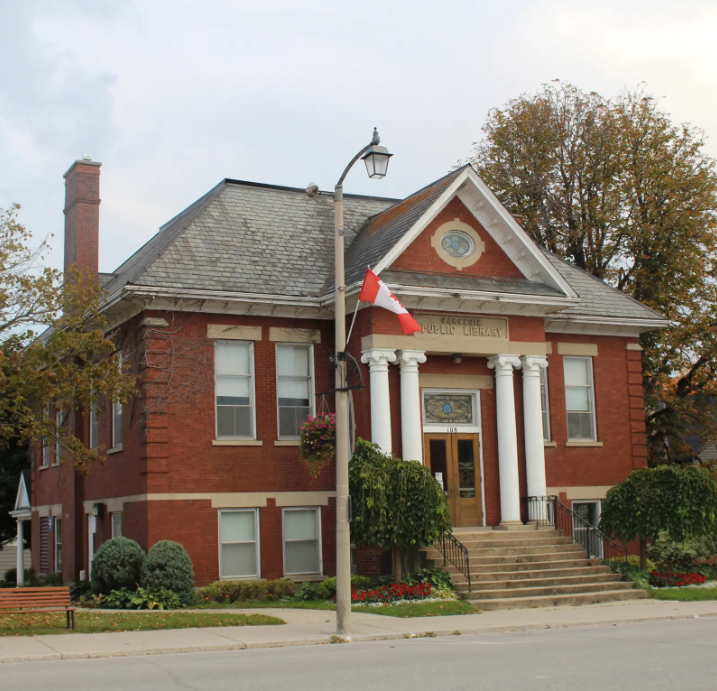
On June 12, 2012, the Bayfield Post Office building on Main Street was demolished to make way for the new Bayfield Branch. Just seven months later, in January of 2013, the new location was ready for use. The old library in the Georgian building was closed for a week while the move took place. The new building has outdoor access to public washrooms and post office boxes. It also features a community room and a large fireplace. The new location opened on January 14, 2013, and the library has been there ever since. 

Summer Reading Week 5: Journey to the Poles

Summer Reading Week 5: Journey to the Poles

Dear Summer Reading Kids,

This week, we bundled up and travelled to the icy ends of the earth with Journey to the Poles!

We explored the Arctic and Antarctic seas. We learned about animals that call these cold places home, like polar bears, seals, and whales. We also learned how they survive in such extreme environments.

We read Oona in the Arctic by Kelly DiPucchio following a journey to return a whale cub back home to the north.

Our craft was a beautiful Northern Light kaleidoscope, inspired by the colourful aurora dancing across the sky. We also played some exciting Minute to Win It games, including blindfolded pickup challenges, cup stacking competitions and a balloon race that had everyone laughing!

If you couldn’t join us, try creating your own northern lights artwork using bright colours or drawing your favourite polar animal. We have colouring sheets that you can print at home or at your local library. We also encourage you to check out some books from our Week 5 reading list while you’re visiting!

Bundle up and keep reading. We’ll see you next week for a swashbuckling adventure!

Sincerely,
Giselle and Sarah

Summer Reading Week 4: The Incredible Great Lakes

Summer Reading Week 4: The Incredible Great Lakes

Dear Summer Reading Kids,

This week, we explored something very close to home: the incredible Great Lakes!

With our theme Wonders of the Great Lakes, we learned just how large and important these freshwater lakes are. They support wildlife, provide drinking water, and are an important part of life here in Huron County.

We read The Great Lakes by Barb Rosenstock and discovered fascinating facts about these powerful and beautiful bodies of water.

For our craft, we created our own lighthouses, using a variety of materials to design structures that help guide ships safely along the shore. Each lighthouse was bright, creative, and unique!

We also had fun playing Magnet Go-Fishing, where everyone tested their skills to “catch” lake creatures.

If you couldn’t make it, try drawing your own lighthouse or reading a book about Lake Huron. Maybe even visit the shoreline and see what you can discover! We have a colouring sheet that you can print at home or at your local library. We also encourage you to check out some books from our Week 4 reading list while you’re visiting!

Keep reading. We’ll see you next week for a chilly adventure!

Sincerely,
Giselle and Sarah

Summer Reading Week 3: River Rush

Summer Reading Week 3: River Rush

Dear Summer Reading Kids,

This week, we followed the current into an exciting new adventure with River Rush!

Rivers are always moving, always changing, and always connecting places and people. We learned how rivers flow through communities, provide habitats for wildlife, and shape the land around them.

We enjoyed the story Lights Along the River by Pat Skene, imagining what it would be like to travel beside a glowing, winding river.

For our craft, we designed and decorated our own pool noodle sailboats, each one unique and full of personality. Then we tested them in our exciting River Race, cheering as our boats raced along! We also played River and the Bank, a fast-paced game that kept everyone on their toes.

If you couldn’t join us, try making your own mini boat at home using recycled materials. See if it floats in a sink or tub with a grown-up nearby! We have colouring sheet that you can print at home or at your local library. We also encourage you to check out some books from our Week 3 reading list while you’re visiting!

You’re all doing an amazing job. See you next week as we explore even bigger waters!

Sincerely,
Giselle and Sarah

Summer starts at the Huron County Library

Summer starts at the Huron County Library

This summer, make the Huron County Library your destination for discovery, creativity, and connection. Whether you’re looking to keep young minds engaged, explore new hobbies, or simply spend time together, the library offers a season full of free activities, great books, and memorable experiences. 

Join the Club: There is still time to join the TD Summer Reading Club! This exciting and educational program is free to readers aged 4-12 and runs in-person at all 12 Huron County Library branches from June 29-Aug. 21.  While some locations are currently full, please still register if you would like to be added to the waitlist.

Stay cool: Beat the heat by borrowing a pool pass for Seaforth, Exeter, Kirkton-Woodham, and Brussels, Morris & Grey pools. During extreme heat events, drop into any one of our 12 branches during open hours to cool down and enjoy all the library has to offer.

Visit a Museum: Did you know you can visit the Huron County Museum & Historic Gaol for free when you show your Huron County Library card? If you have family or friends visiting from outside of Huron County, you can borrow a Family Pass so they can join you on your visit. Or take a day trip to the Royal Ontario Museum or London Children’s Museum.

Get outdoors: There are no shortage of parks, trails, and beaches in Huron County to unplug and explore this summer. Borrow an Ontario Parks day pass to visit more than 100 provincial parks. Stay closer to home by checking out a day pass to Falls Reserve Conservation Area. Or explore what’s in your own backyard by borrowing a telescope or bird watching kit.

Try something new: There are no shortage of activities taking place in our branches this summer. Join a LEGO challenge, meet your friends to watch soccer together, get creative through a variety of art and craft programs, and so much more! 

Read: Or you could just borrow a book and enjoy a quiet moment reading. Get started by browsing our online catalogue or check out what library staff are reading this summer.

History of the Clinton Branch

History of the Clinton Branch

Next up in our library history series, let’s take a little jaunt over to Clinton. The first library in Clinton was again a Mechanics’ Institute and it was housed in the Town Hall in 1872. Just seven years later, in 1879, the Town Hall burned, taking the Mechanics’ Institute along with it. The fire destroyed all library records and nearly all the books. It was undoubtedly a sad day for both the Clinton community and librarianship.

But it would take more than a fire to keep the Clinton Mechanics’ Institute down. Shortly afterwards, the Institute reopened with temporary accommodation in the Victoria buildings. The librarian at the time, a certain Mr. James Scott, was not only the librarian – he also taught night classes at the library. Seems like a good use of the space.

A couple years later, in 1887, all residents of Clinton were granted free admission to the library and the reading room, but were not permitted to take any books home. Imagine that – a library where you couldn’t borrow any books! If we told someone that today, they probably wouldn’t understand what was happening.

Just a few years after this, an interesting and quite unique story proceeded to unfold. In 1890, Mr. James Staveley, a Clinton resident, passed away. Mr. Staveley was a well-to-do landowner and businessman, and he left no heirs. He willed his estate to a relative who had, unbeknownst to Mr. Staveley, died before him, and so the estate passed to this relative’s heirs in the United States. But apparently this didn’t sit well with some movers-and-shakers of the day, and these 19th century influencers decided that non-residents should not be entitled to Mr. Staveley’s windfall. So, in their wisdom, they petitioned the provincial government to overturn the will. I don’t know about you, but I’ve never heard of something like this happening. They suggested that the inheritance should go to the Town of Clinton, and that the funds could go towards erecting a public hall for the use of the town.

It’s a long story, and a bit too complicated for our purposes to go into all the details, but in the end, the Staveley Hall, which housed the library, was built with Staveley’s funds and opened in 1900. This created an unusual situation when Andrew Carnegie showed up shortly after this with possible grants for libraries to be built in Huron County. Carnegie wanted to gift a library to towns that did not already have one, and might not get one. Carnegie and his employees felt that towns and villages that didn’t already have a library were more deserving or were in more desperate need, and so those communities were chosen to be given grants.

This was true of all communities that received a Carnegie grant across Ontario, except one – Clinton. With the Staveley Hall library building so recently completed, the Town decided to ask for the grant money in order to build an addition. The request was granted, and Clinton became the only Ontario community with a Carnegie grant that went towards an addition to an existing building.

Since the Clinton Library is still housed in this building today, anyone can go and see this. If you do go, the original Staveley building is the two-story part of the building to the north, and the Carnegie addition is the one-story portion to the south.

In 1978, the library was designated as a heritage building by Clinton council, which immediately protected the building from demolition and any major changes that might damage its architectural features or historical significance. This designation may have saved it.


Just a few years later, in the summer of 1981, this headline was on the front page of the July 30 issue of the Clinton News Record – ”Library may be sinking”. According to the article, “Clinton’s stately library … is presently under examination and a feasibility study may be conducted to determine how structurally sound the building actually is.” The article also mentions that “… (it’s) said to be sinking and rumoured to be sitting on a bed of quick sand” and “suspicion shows that the library foundation may be sinking, seen from the noticeable lean on the basement floor.”

Well, that was quite the rumour! Correct me if I’m wrong, but I don’t think it proved to be a true one.

In addition to the foundation needing to be checked out, by 1981, the second floor was approaching 20 years since it had been abandoned, and so had fallen into disrepair. At that point, it was being used for storage and occasionally as a meeting space.

Here’s one reporter’s description.

“A climb up the once elegant old winding staircase leads to the second story of the Clinton library building. Although run down and dirty, the seldom used room is still architecturally intriguing with its large windows and deep woodwork.”

Just to pile on, some parts of the roof were in need of repair. Needless to say, seems like the old building needed some attention!

Once the evaluation was completed, in 1982, it was announced that the library was no longer structurally sound. As a result, library operations were shifted to the empty former Pro Hardware store on Albert Street. Staff and volunteers took on the huge task of transferring equipment, furniture, and 21,000 books to the temporary location. I wonder if they made a human train and passed the books down the street from one person to the next!

The municipal council at the time agreed to renovate the existing structure. The second floor was included in the renovations and was transformed into “a bright children’s library, complete with a story room”, which remains largely the same to this day. Other work included refurbishing the original stained-glass windows, replacing glass where needed, restoring the original oak circulation desk, replacing furniture, and retaining the tin ceiling. In other words, sounds like everything that needed attention, got it.

About two years later, in March 1984, it was reported that the library would be closed so everything could be moved from the hardware store back to the newly renovated library. It took library workers and volunteers 2 weeks to pack up hundreds of boxes of books and transport them, along with the equipment and some furniture, back to the Staveley building. 

Just a couple months later in May, there was an afternoon open house to showcase the newly renovated space. More than 125 people took in a completely transformed library, most of whom were no doubt impressed by the changes. 

More recently, the Clinton Library has seen a major overhaul in its layout with a new front desk and new shelving on the main floor. And in 2025, a lift was added to make the second floor fully accessible for the first time ever!


About two years later, in March 1984, it was reported that the library would be closed so everything could be moved from the hardware store back to the newly renovated library. It took library workers and volunteers 2 weeks to pack up hundreds of boxes of books and transport them, along with the equipment and some furniture, back to the Staveley building. 

Just a couple months later in May, there was an afternoon open house to showcase the newly renovated space. More than 125 people took in a completely transformed library, most of whom were no doubt impressed by the changes. 

More recently, the Clinton Branch has seen a major overhaul in its layout with a new front desk and new shelving on the main floor. And in 2025, a lift was added to make the second floor fully accessible for the first time ever!