This month we’re moving over to the East Team’s other branch, Brussels. As with most communities, Brussels’ first library was a Mechanics’ Institute. Theirs was established in 1874. The exact location where the Institute was first housed is unknown, but a financial report from 1880 shows there were 28 annual subscribers and 572 volumes.
A couple years later, the library moved from WHEREVER it was to the Little Brothers’ store. They were, according to my records, local proprietors. The Little Brothers store was touted “among the best of the business buildings”, so there you go. Good choice for a library, I guess.
In 1906, we hear a familiar story, but this time with a few twists. The idea of a Carnegie Library was introduced to the Library Board by Mr. John Leckie, the Reeve at the time, and a committee of four men was set up in order to investigate the question more thoroughly.
Later that year, a by-law was submitted to electors asking them to determine whether the Town Hall should be removed and the market be disestablished in order to provide a site for the library building.
This did not go over well AT ALL. Many people protested the by-law, saying such actions would involve destroying useful and valuable property. Citizens also protested that the majority that was in favour of the by-law was due to misrepresentations made to the voters by some of the canvassers and members of the council. Needless to say, there seems to have been some division on this issue back in 1906.
In response to this, a special meeting of the Brussels Council was held in early 1907. A letter from our friend Mr. James Bertram (Carnegie’s private secretary) was read. Mr. Bertram stated that money was available for a library building, provided a site could be procured and an assurance could be given that 10% of the grant’s value would be spent annually on the library building’s maintenance. A vote was taken and a majority passed to move ahead with building the Carnegie library. A $7,000 grant was received shortly thereafter.
How the Carnegie Library Building came to stand at the corner of Turnberry and Mills Streets seems to have arisen from numerous disagreements. Despite the majority vote to move ahead, a site had still not been chosen or agreed on.
A new plan was proposed to use the space adjacent to the Town Hall, thus leaving the building intact. The Reeve at the time opposed this apparently sordid scheme (as evidently did some other citizens), as the proposal was proven unsatisfactory and rejected. Instead, the present location on the corner of Turnberry and Mills Streets was proposed and subsequently purchased from Mr. Henry James for $375.
This wasn’t quite the end of the story, however. Barrister A.H. Monteith, who was the petitioners’ lawyer, and his few followers, continued to protest. Perhaps they picketed and shouted something like, “No no, we can’t put a library there! It’s a terrible idea that will be a disaster!” But that’s just a guess.
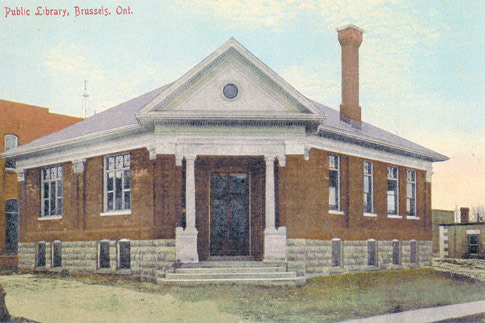
Despite these ongoing protests, excavation finally went ahead in 1909, and the new library opened on Jan. 14, 1910. The citizens were evidently pleased with the building, for the Brussels Post proudly stated on Dec. 8, 1910 that “Brussels possesses the neatest and most modern public library building in 5 counties.” Talk about high praise!
Here’s an interesting side note about the building – the Brussels library is one of only six Carnegie libraries in Ontario to have a corner entrance, and the only one in Huron County. It’s a rarity, and for good reason. Mr. Bertram, who oversaw the Carnegie grant program, was apparently quite frugal, and he believed corner entrances were extravagant.
Here’s another snippet from the building’s history. During the Second World War, the basement of the library was used by the Red Cross and old magazines were sent to the forces overseas. When the soldiers returned in 1945, some of the men created a display of war souvenirs for the library. Libraries played their part in the War, even libraries in faraway Brussels, ON.
Over the course of several months in 2004, the teen and children’s areas of the library were rejuvenated and redecorated. A teen room was designated and painted colourfully, with lime green, blue, purple, and orange splashed across the walls. Sounds like a fun space! It also featured two orange comfy chairs, a café table with four stools, and various board games.
Meanwhile, the redecorated kids room featured several computers with children’s programs, two tactile-focused discovery centres featuring the themes “travel” and “fairy tales”, and all the children’s books up to grade 4.
Not long after this, sometime in 2007, two things happened. One, Huron East council passed a by-law that designated Brussels’ Carnegie library as a heritage building, meaning it could not be demolished. Two, Huron East council voted to build a new library rather than renovate and build an addition on to the Carnegie building.
However, the project was shelved, an election happened, and a new council was voted in. This council revisited the library decision, and while they seemed more interested in keeping the library at the Carnegie building, the costs gave them pause.
It was about this time, around 2011, that local architect and Brussels-native John Rutledge submitted some ideas on how to expand the current library, make it accessible, and preserve its history. As a result, council began moving forward with a project that would see the preservation of one of the village’s most historic buildings.
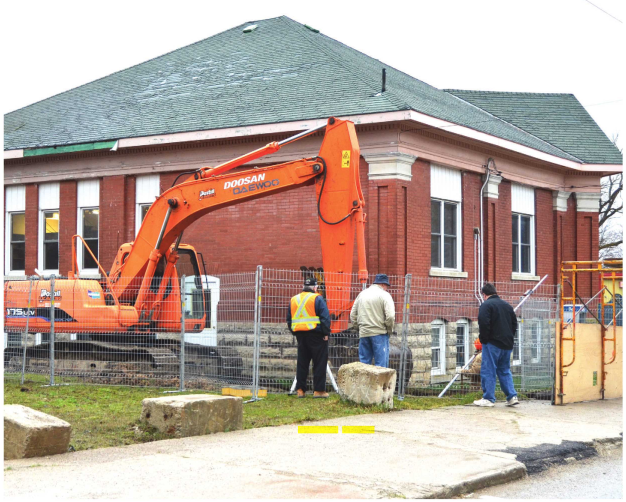
Shortly after the building reached the ripe old age of 100, it received some much-needed renovations, as well as an addition, with construction starting in April 2013. Huron East received a $147,167 grant from the federal government in order to complete the project.
One of the primary needs was to introduce a new, fully accessible entrance. After much deliberation, it was decided that the new entrance should be off Turnberry Street (Brussels’ main street), with a 60-foot-long ramp leading to the doors of the addition. As a result of this new accessible entrance, the original corner entrance was locked and the space inside those doors was turned into a new adult reading room.
Inside the original building, there was a focus on increasing accessibility while respecting the historic architectural character of the building. To achieve increased accessibility, three smaller rooms with solid walls were opened up with new archway openings, and one large open archway was created between the original building and the addition.
A renovation done in the 1970s had dropped the ceiling to potentially make the building easier to heat, which caused a window to be boarded up and thus lowered natural light levels. During this renovation, the ceiling was raised back up almost to its original height, which revealed and reinstated the window.
As for the addition, it was built onto the backside of the original building, bringing the library space up from 1,900 square feet to 2,600 square feet. The main part of the addition is a large community program room, with the rest comprised of three washrooms and a foyer for the accessible entrance.
While the building was being worked on, the library was temporarily moved into the former Brussels Public School building, which was the Brussels Business and Cultural Centre at the time. It took only two days to get up and going at the temporary location. Quite quick!
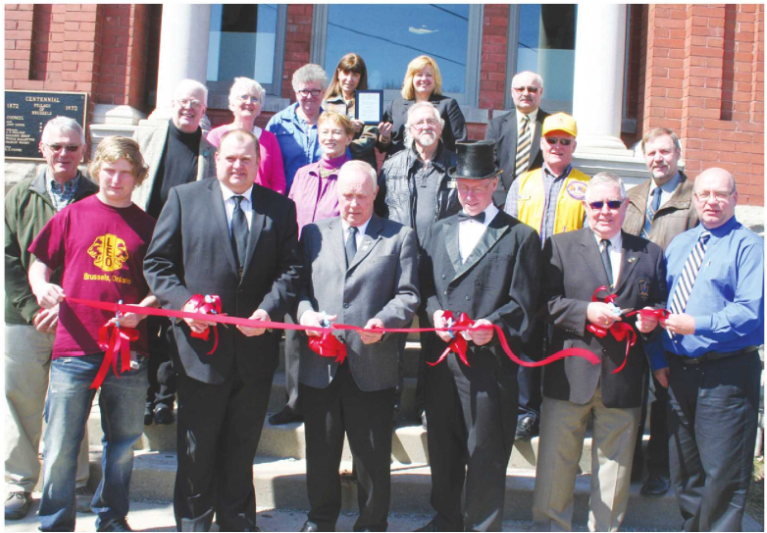
Ten months later, the building addition and renovations were completed and the library was moved back in, along with the original tables and chairs that were refinished and reinforced. The original re-open date was set for Feb. 21, but thanks to severe winter weather closing all highways and County roads, work had to be halted for a few days. After three days of moving everything, the library officially opened again at the end of February 2014 and has been in operation ever since, ending a process that had gone on for nearly 10 years.