
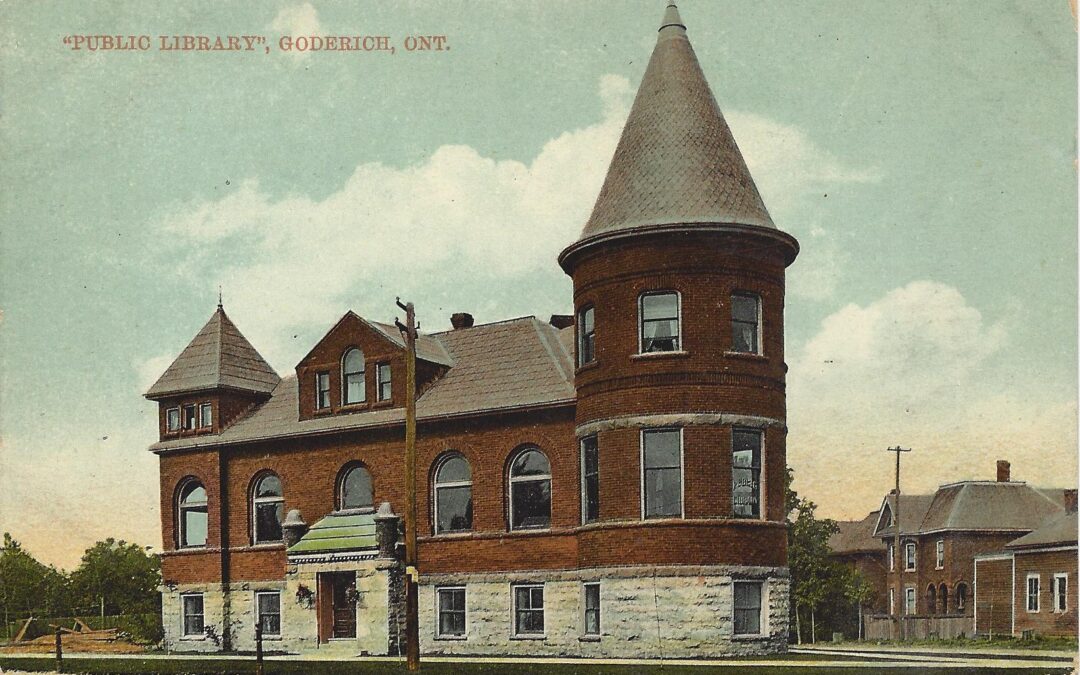
Next up, we’re heading to the biggest town in all of Huron County – Goderich. The first mention we get of a library in Goderich is, surprise surprise, a Mechanics’ Institute! The earliest mention we have is 1868, at which time the minutes reported that there were library rooms in the Grammar School which was “in very good order and the books well kept.”
Despite this favourable report, just a year later, the rooms were moved to the corner of East Street and the Market Square. These rooms were above Mr. Francis Jordan’s drugstore, and the Mechanics’ Institute rented them for a whopping $4 a month.
However, these early days were turbulent times. Just one year later, the rooms were closed, the furniture was disposed of, and the books were given to the Common School Trustees. And just like that, it was all over!
Well, not quite ALL over. The Institute attempted to enlist the support of the Town of Goderich. It offered the council its rights to lots number 852 and 856 on North Street and all its cash on hand. In exchange, the Institute members asked for a building suitable for accommodating a library.
But their request was soundly rejected. After nursing their wounds, the Mechanics’ Institute disbanded and the North Street lots went to the Sons of Temperance. Although this group sounds intriguing, we best not go down that rabbit hole.
Our story picks up again almost a decade later, in 1879. In that year, it was resolved that a new society be formed, and it would be called “The Goderich Mechanics’ Institute and Library Association.” The library books that had been given to the Common School Trustees were moved from the central school to Mr. Butler’s rooms, where Mr. Butler took up the role of librarian. I’m not sure where the Butler’s rooms were as there’s no readily available information on that. Just two years later, in 1881, the library was moved to the upper flat of a brick building on the corner of East Street and the Square. These were known as Mr. Crabb’s rooms. What great names these fellows had! Mr. Crabb and Mr. Butler.
In these early days of librarianship in Goderich, the Mechanics’ Institute did not restrict its services to just the lending of books. A variety of courses were frequently offered to teach different topics to various pupils.
By 1885, the Reading Room became free of charge. However, the chess and checkerboards in this room were reserved for the use of “Members Only”.
Less than 10 years later, in 1894, the library moved once again, this time to Mr. McClean’s rooms. Unfortunately, again, I could not find the location in the research.
Let’s jump ahead a bit now, to 1902. After some correspondence between the Mechanics’ Institute and Andrew Carnegie (there’s a familiar name), the Town of Goderich was offered a $10,000 grant to build a new library on the conditions that $1,000 would be spent annually on the library’s maintenance, and that a site could be provided.
Once this grant was accepted, it was time to decide on a suitable site for the new building. What followed was the lengthy decision process in order to pick said suitable site. Before a final decision was reached, there were numerous suggestions voiced through the editorial page of the newspaper and the public council meetings held for the citizens.
The suggested sites included:
- The old skating rink corner property on West Street.
- The property next to the Bank of Commerce.
- Various sites on North Street and Kingston Street.
- The corner of East Street and the Square where McLean’s Butcher Shop stood at the time.
Despite the multitude of different opinions on what the best site would be, everyone could agree that a new library was needed as the current one was, and I quote, “a disgrace to the town.”
In the end, the Goderich Library Board decided to ask Town Council to, “appropriate a sufficient portion of the Market Lot, nearest the Square for the purpose of a Library Building.” The lot, number 118, was on the corner of Montreal and Lighthouse Streets and measured 90 feet in length.
Despite this decision being made in March of 1903, building did not progress as quickly as hoped. It wasn’t until November, 1904, nearly two years later, that the Library Board informed Mr. McLean (from whom they had rented rooms since 1894, following Mr. Crabb), that they would be vacating the reading room and library in his building early in 1905.
When the new library finally opened on March 3, 1905, the event was so big that viewing of the building was only permitted from 2 to 6 p.m., and again from 7-8 p.m.
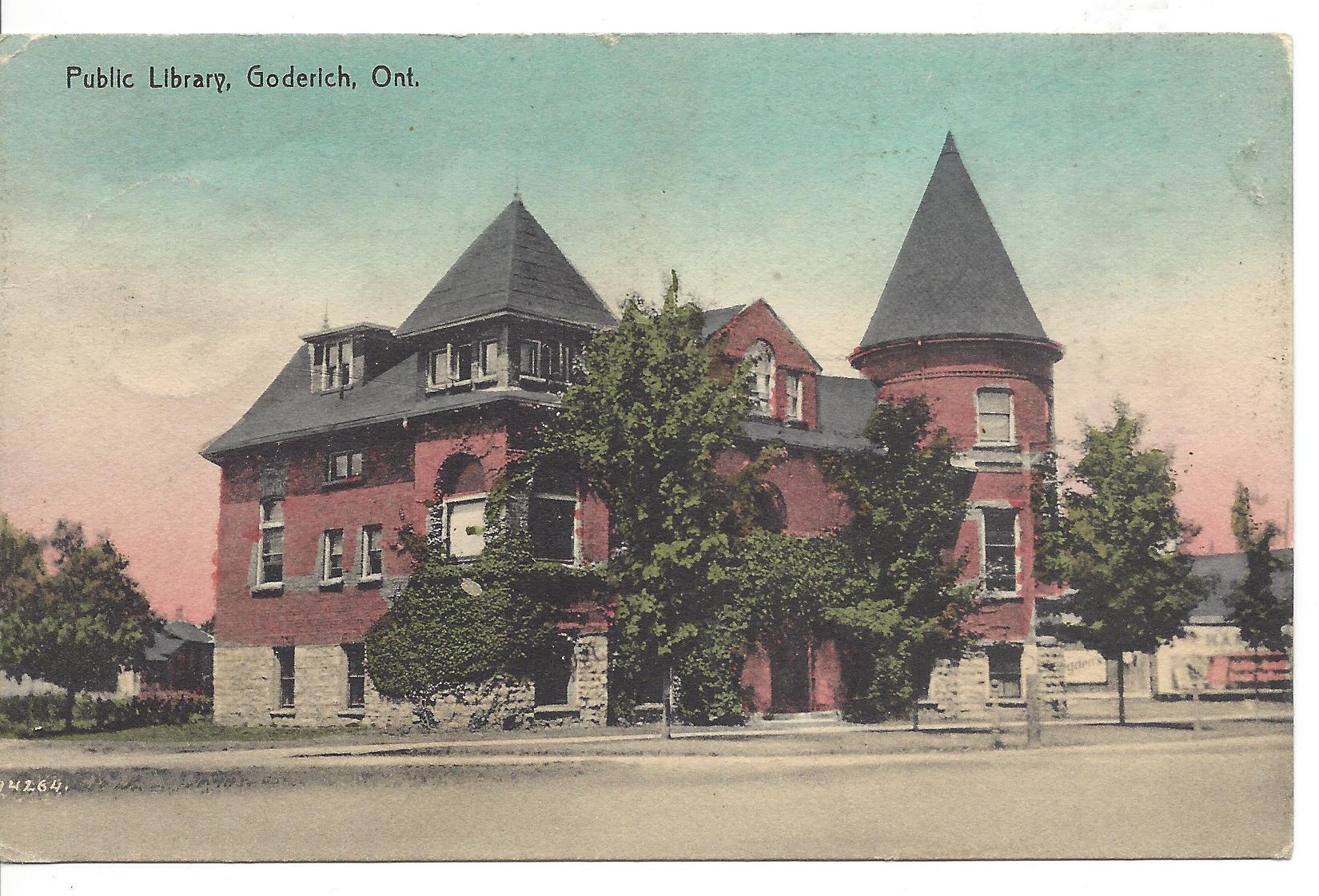
The Carnegie grant was overspent, but the difference was made up from the general fund. The unusual design of the Goderich Library included two towers and living quarters for the librarian on the top floor. Mr. James Bertram, Carnegie’s private secretary and one of the managers of the library building grants program, would never have approved this design had it been proposed at a later date.
How do we know this? By 1907, Mr. Bertram, due to his deep concerns about some of the poorly designed early libraries, insisted on receiving plans of all proposed buildings moving forward so he could carefully examine them. He was very critical of wasted space; high ceilings, elaborate rotundas, and inefficient use of floor space were all no-no’s in his books. If he had been allowed to see the designs for Goderich’s library, he would have said something like, “Oh no, look at these high ceilings and elaborate rotundas. These simply won’t do!”
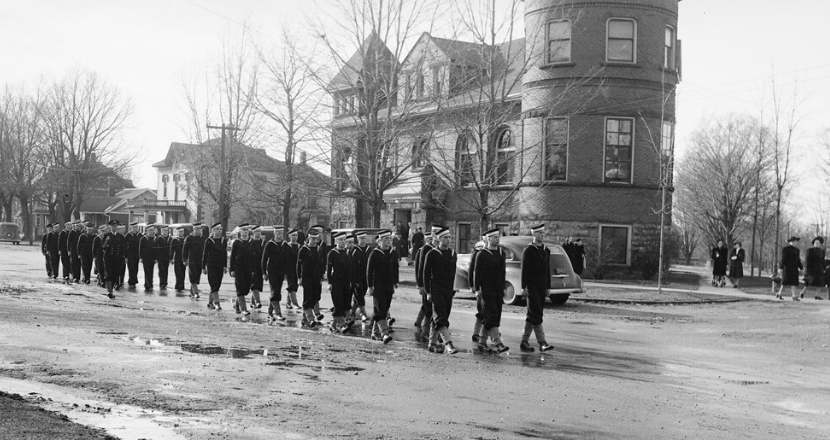
120 years later, the Carnegie building still stands and continues to operate as the Goderich Branch of the Huron County Library, with the building receiving only minor damage when the tornado hit in 2011. Having said that, the uses of the building and the collections contained within it have evolved along the way. In 1908, books became “free access” (except for fiction). In other words, prior to 1908, access to borrowing books was somehow restricted. Just wild.
At certain times, the library was temporarily closed. Cases where this happened include the smallpox epidemic in 1907 and 1920, and a fuel shortage in 1918. Closing for smallpox epidemics reminds me of 2020 when all our libraries were closed due to COVID. That’s something I’ll never forget.
Remember when I said there were living quarters for the librarian built on the top floor? In those early days, this is exactly what happened. Goderich’s librarian lived on the third floor of the library. So cool! Unfortunately, I couldn’t find when this unique living situation ended.
However, I did find that beginning in 1934, these upper rooms were used as a museum and to store town records, so it’s safe to assume no one was living up there at by 1934. This use of the space continued until the opening of the Huron County Museum in 1951, at which point everything was moved out of the upper rooms and into the new museum on North Street, which is where the museum remains to this day.
In 1947, after attempting to do so for many years, the Maple Leaf Chapter IODE finally established a permanent children’s library in the basement. In 1950, a vacant room in the basement was redecorated and rewiring was done throughout the building. In 1958, a telephone was installed – that must have been a big change! And in 1960, new floor tile was laid in the children’s area.
About 40 years later, in 2001, the IODE went several steps further when they initiated a major $1.6 million community-led renovation/addition project to modernize the nearly 100-year-old building. A one-storey addition with a mezzanine was added to the west side of the original Carnegie structure, effectively doubling the library’s total floor space. A fully-accessible front entrance and elevator were added for the first time. The existing interior of both the upstairs and downstairs were renovated with a view towards modernizing and transforming the children’s section into a more open, inviting space. To keep pace with expanding community needs, a new circulation desk area was set up in the new addition and expanded from a single workstation to three workstations. Public computer access expanded to 10 workstations. The brand-new mezzanine became the Reuben R. Sallows Art Gallery, which showcases the photographer’s life timeline and historic local photography. In fact, the only area that was untouched by the project was the former librarian living quarters on the third floor. No longer used for this purpose for many years, the historic rooms still retain pieces of original historic wallpaper and period decor.
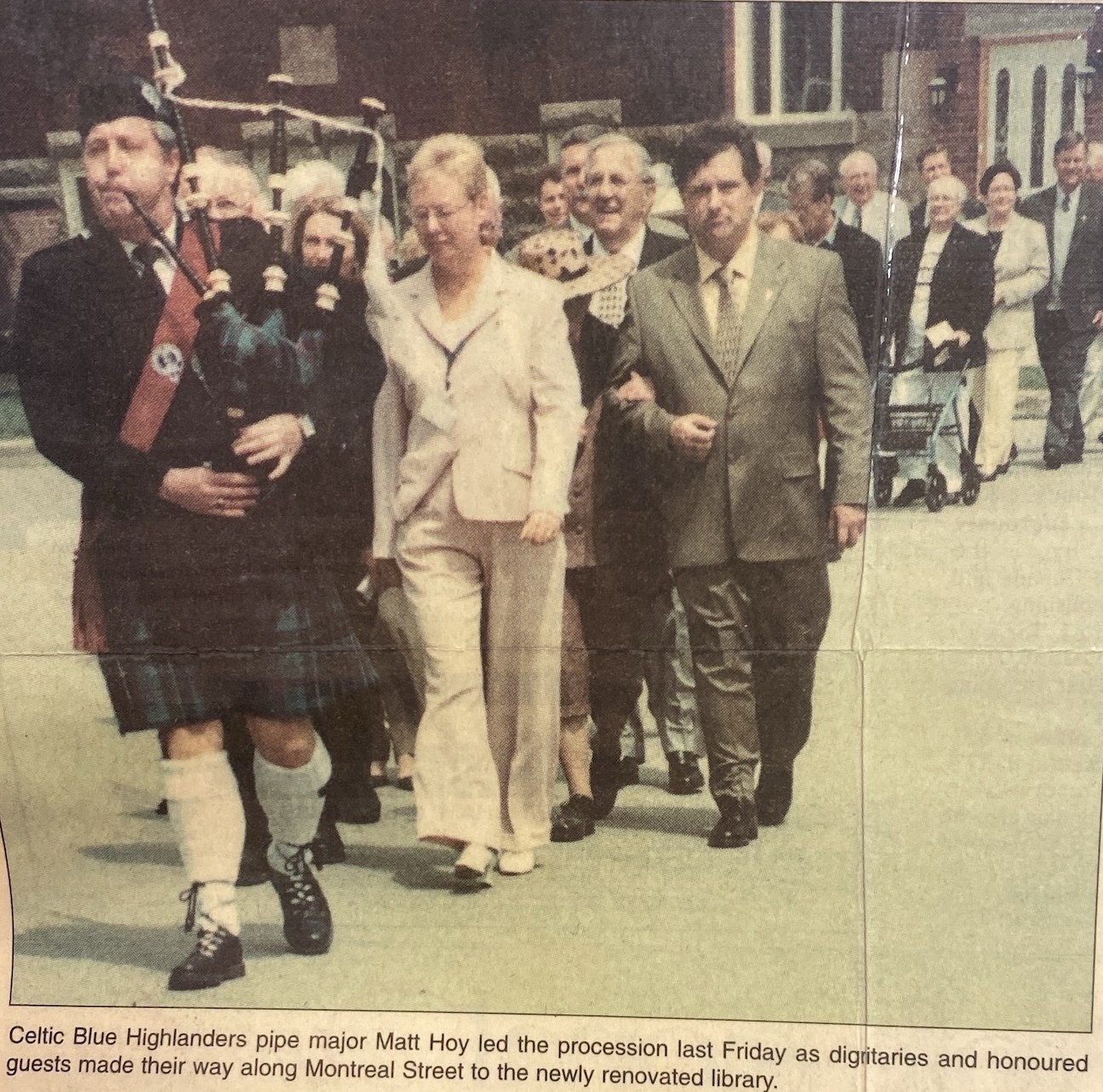
During the construction, the library was moved into the double storefront to the right of what was once Fincher’s (now Bee’s Knees Books & Emporium) on the Square. It moved back into the newly renovated and expanded building in 2003. The official reopening on June 6 saw an estimated 300 attendees enjoy the festivities, which included two plaque unveilings, a bagpiper-led procession, speeches, and words of thanks.
Even more recently, there’s been changes as well. The children’s area has moved up to the main floor, a room in the basement is used for people to use the library’s VR headsets, and there’s a room upstairs where youth can play Nintendo video games or just hang out.
Although I think it’d be very cool if someone did, current Goderich library staff do not live in the upper floor of the library. That third floor has fallen into disuse. Alas, not every idea or design bears fruit forever.

Huron County Library
77722B London Rd
RR 5 Clinton, ON
N0M 1L0